 |
Os motores de busca de Datasheet de Componentes eletrônicos |
|
|
Os motores de busca de Datasheet de Componentes eletrônicos |
|
The question interval is too short.
Please try again in a few seconds.

Hello, Please ask a question about AD9775 Datasheet
# Example questions:
➢ What is the minimum acceptable clock pulse width (high) for the serial control bus (sclk)?
➢ What is the maximum input capacitance for digital inputs like sdi, sdio, sclk, and csb?
➢ What is the spurious-free dynamic range (sfdr) at a data rate of 65 msps and an output frequency of 15 mhz, according to the provided specifications?
| Part No. | AD9775 |
| Manufacturer | AD |
| Size | 1Mb |
| Pages | 56 pages |
| Description | 14-Bit, 160 MSPS, 2횞/4횞/8횞 Interpolating Dual TxDAC+짰 Digital-to-Analog Converter |






1. General Overview
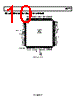
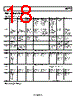
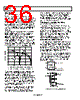
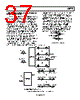
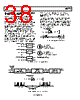
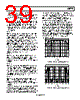
️· What it is: The AD9775 is a high-speed digital-to-analog converter (DAC). It’s used in communications systems, test equipment, and other applications requiring precise analog signal generation.
️· Focus: The extract covers its electrical specifications, digital interfaces, and performance characteristics.
2. Digital Specifications (Interface and Control)
️· Digital Input Voltages:
- Logic 1: 2.1V
- Logic 0: 3V
️· Serial Control Bus:
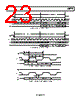
- Maximum Serial Clock (SCLK) Frequency: 15 MHz (critical for data transfer speed)
- Minimum Pulse Widths: Ensures reliable clock signals (tPWH and tPWL)
- Data Valid Time: Defines when the DAC must read data on the serial bus (tDV)
- Reset Pulse Width: Specifies the duration of the reset signal (Important for Initialization)
️· SDIO Output (Serial Data Output):
- Similar voltage levels as digital inputs.
- Drive Capability: The output can drive a load (DRVDD - 0.6 V – means the output can sink or source current within certain voltage limits)
3. Analog Performance (Key for Signal Quality)
️· Dynamic Range: Measures how much signal can be represented without distortion
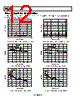
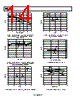
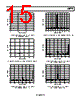
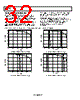
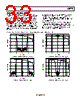
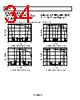
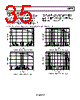
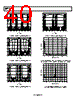
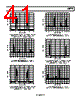
- SFDR (Spurious-Free Dynamic Range) to Nyquist: 71-84.5 dBc (Decibels relative to carrier) – High SFDR indicates low noise and distortion.
- IMD (Intermodulation Distortion): Measures distortion when multiple tones are applied – Good IMD values are crucial for multi-tone applications.
- THD (Total Harmonic Distortion): A measure of the unwanted harmonic components - lower is better.
- SNR (Signal-to-Noise Ratio): The ratio of signal power to noise power – higher is better.
️· AC Linearity:
- Four-Tone Intermodulation (IF Mode): Important if the DAC is used in an intermediate frequency (IF) architecture.
️· Baseband Mode: Relevant for direct signal generation
4. Analog Input Specifications (Not detailed in the extract, but essential)
️· These are missing in the provided extract. Critical parameters would include:
- Settling Time: How quickly the output voltage reaches a new value.
- Output Voltage Range: The maximum and minimum output voltage levels.
5. Key Takeaways & What to Focus On
️· High-Speed Operation: The AD9775 is designed for high-speed applications, with a maximum SCLK frequency of 15 MHz.
️· Signal Quality: The SFDR, IMD, THD, and SNR values are crucial for ensuring high-quality analog signals.
️· Interface Compatibility: The digital interface specifications (voltages, timing) must be carefully matched to the controlling system.
️· Missing Information: The absence of analog input specifications (like settling time and output voltage range) in this extract highlights the need to consult the complete datasheet for a full understanding.
To use this information effectively:
️· Match the SCLK frequency: Make sure your control system can reliably generate the required SCLK frequency.
️· Understand the SFDR/IMD/THD: These dictate the maximum signal level and applications for which the DAC is suitable.
️· Review the Full Datasheet: This is just a partial view – consult the complete document for all specifications and application information.
1. General Overview
️· What it is: The AD9775 is a high-speed digital-to-analog converter (DAC). It’s used in communications systems, test equipment, and other applications requiring precise analog signal generation.
️· Focus: The extract covers its electrical specifications, digital interfaces, and performance characteristics.
2. Digital Specifications (Interface and Control)
️· Digital Input Voltages:
- Logic 1: 2.1V
- Logic 0: 3V
️· Serial Control Bus:
- Maximum Serial Clock (SCLK) Frequency: 15 MHz (critical for data transfer speed)
- Minimum Pulse Widths: Ensures reliable clock signals (tPWH and tPWL)
- Data Valid Time: Defines when the DAC must read data on the serial bus (tDV)
- Reset Pulse Width: Specifies the duration of the reset signal (Important for Initialization)
️· SDIO Output (Serial Data Output):
- Similar voltage levels as digital inputs.
- Drive Capability: The output can drive a load (DRVDD - 0.6 V – means the output can sink or source current within certain voltage limits)
3. Analog Performance (Key for Signal Quality)
️· Dynamic Range: Measures how much signal can be represented without distortion
- SFDR (Spurious-Free Dynamic Range) to Nyquist: 71-84.5 dBc (Decibels relative to carrier) – High SFDR indicates low noise and distortion.
- IMD (Intermodulation Distortion): Measures distortion when multiple tones are applied – Good IMD values are crucial for multi-tone applications.
- THD (Total Harmonic Distortion): A measure of the unwanted harmonic components - lower is better.
- SNR (Signal-to-Noise Ratio): The ratio of signal power to noise power – higher is better.
️· AC Linearity:
- Four-Tone Intermodulation (IF Mode): Important if the DAC is used in an intermediate frequency (IF) architecture.
️· Baseband Mode: Relevant for direct signal generation
4. Analog Input Specifications (Not detailed in the extract, but essential)
️· These are missing in the provided extract. Critical parameters would include:
- Settling Time: How quickly the output voltage reaches a new value.
- Output Voltage Range: The maximum and minimum output voltage levels.
5. Key Takeaways & What to Focus On
️· High-Speed Operation: The AD9775 is designed for high-speed applications, with a maximum SCLK frequency of 15 MHz.
️· Signal Quality: The SFDR, IMD, THD, and SNR values are crucial for ensuring high-quality analog signals.
️· Interface Compatibility: The digital interface specifications (voltages, timing) must be carefully matched to the controlling system.
️· Missing Information: The absence of analog input specifications (like settling time and output voltage range) in this extract highlights the need to consult the complete datasheet for a full understanding.
To use this information effectively:
️· Match the SCLK frequency: Make sure your control system can reliably generate the required SCLK frequency.
️· Understand the SFDR/IMD/THD: These dictate the maximum signal level and applications for which the DAC is suitable.
️· Review the Full Datasheet: This is just a partial view – consult the complete document for all specifications and application information.
| Part No. | AD9775 |
| Manufacturer | AD |
| Size | 1Mb |
| Pages | 56 pages |
| Description | 14-Bit, 160 MSPS, 2횞/4횞/8횞 Interpolating Dual TxDAC+짰 Digital-to-Analog Converter |
| ALLDATASHEET é útil para você? [ DONATE ] |
Sobre Alldatasheet | Publicidade | Contato conosco | Privacy Policy | Link para a ficha técnica | roca de Link | Lista de Fabricantes All Rights Reserved©Alldatasheet.com |
| Russian : Alldatasheetru.com | Korean : Alldatasheet.co.kr | Spanish : Alldatasheet.es | French : Alldatasheet.fr | Italian : Alldatasheetit.com Portuguese : Alldatasheetpt.com | Polish : Alldatasheet.pl | Vietnamese : Alldatasheet.vn Indian : Alldatasheet.in | Mexican : Alldatasheet.com.mx | British : Alldatasheet.co.uk | New Zealand : Alldatasheet.co.nz |
|
Family Site : ic2ic.com |
icmetro.com |
 Portuguese ▼
  English
 Chinese
 German
 Japanese
 Russian
 Korean
 Spanish
 French
 Italian
 Polish
 Vietnamese
 Indian
 Mexican
 British
 New Zealand