|
Os motores de busca de Datasheet de Componentes eletrônicos |
|
|
Os motores de busca de Datasheet de Componentes eletrônicos |
|
ADP151 Folha de dados(PDF) 30 Page - Analog Devices |
|
|
|||||||||||||||||||||||||||||
ADP151 Folha de dados(HTML) 30 Page - Analog Devices |
|
|
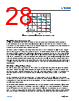
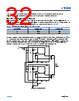
30 / 47 page  Data Sheet LT3046 analog.com Rev 0 30 of 47 resistor-divider. Many low-noise regulators pin out their voltage reference to allow for noise reduction by bypassing the reference voltage. Unlike most linear regulators, the LT3046 does not use a voltage reference. Instead, the LT3046 uses a 100μA current reference. The current reference operates with a typical noise-current level of 20pA/√Hz (6nARMS over a 10Hz to 100kHz bandwidth). The resultant voltage noise equals the current noise multiplied by the resistor value, which, in turn, is RMS summed with the noise of the error amplifier and the thermal noise of the resistor, √4kTR, where k = Boltzmann constant (1.380649 × 10⁻²³J/K), and T is the absolute temperature. One problem that conventional linear regulators face is that the resistor-divider setting the output voltage gains up the reference noise. In contrast, the unity-gain follower architecture of the LT3046 presents no gain from the SET pin to the output. Therefore, if a capacitor bypasses the SET pin resistor, the output noise is independent of the programmed output voltage. The resultant output noise is then set only by the noise of the error amplifier, typically 2.2nV/√Hz from a 10kHz to 1MHz bandwidth and 0.8μVRMS from a 10Hz to 100kHz bandwidth using a 4.7μF SET pin capacitor. Paralleling multiple LT3046 devices further reduces noise by √N, for N parallel regulators. See Figure 51, Figure 52, Figure 54, Figure 56, and Figure 58 for the noise spectral density (for the 10Hz to 10MHz frequency range and for the 0.1Hz to 10Hz 1/f noise frequency range) and RMS integrated noise over various load currents and SET pin capacitance information. SET Pin (Bypass) Capacitance: Noise, PSRR, Transient Response, and Soft-Start In addition to reducing output noise, using a SET pin bypass capacitor also improves PSRR and transient performance. Note that any bypass-capacitor leakage deteriorates the DC regulation of the LT3046. Capacitor leakage of even 100nA is a 0.1% DC error. Therefore, Analog Devices recommends the use of a good quality, low- leakage ceramic capacitor. Using a SET pin bypass capacitor also soft starts the output and limits inrush current. The RC time constant, formed by the SET pin resistor and capacitor, controls the soft-start time. The ramp-up rate from 0% to 90% of nominal VOUT is the following: ������������������ ≈ 2.3 × ������������������������ × ������������������������ (������������������������ ������������������������������������������ ������������������������������������������������) Fast Startup For ultra-low noise applications that require low 1/f noise (that is, at frequencies below 100Hz), a larger value, SET pin capacitor of up to 22μF is required. Typically, this larger value significantly increases the start-up time of the regulator. However, the LT3046 incorporates fast start-up circuitry that increases the SET pin current to approximately 2.2mA during startup. As shown in Figure 66, the 2.2mA current source remains engaged while PGFB is less than 298mV, unless the regulator is in current limit, dropout, thermal shutdown, or the input voltage is less than the minimum VIN. If the fast start-up capability is not used, connect PGFB to IN or to OUT for output voltages more than 298mV and note that this also disables the power-good functionality. EN/UV The EN/UV pin is used to put the regulator into a micropower shutdown state. The LT3046 has an accurate 1.27V turn-on threshold on the EN/UV pin with 110mV of hysteresis. This threshold can be used with a resistor-divider from the input supply to define an accurate UVLO threshold for the regulator. The EN/UV pin current (IEN/UV) at the threshold from Table 1 must be considered when calculating the resistor-divider network as follows: |
|
Ligação URL |
| ALLDATASHEET é útil para você? [ DONATE ] |
Sobre Alldatasheet | Publicidade | Contato conosco | Privacy Policy | Link para a ficha técnica | roca de Link | Lista de Fabricantes All Rights Reserved©Alldatasheet.com |
| Russian : Alldatasheetru.com | Korean : Alldatasheet.co.kr | Spanish : Alldatasheet.es | French : Alldatasheet.fr | Italian : Alldatasheetit.com Portuguese : Alldatasheetpt.com | Polish : Alldatasheet.pl | Vietnamese : Alldatasheet.vn Indian : Alldatasheet.in | Mexican : Alldatasheet.com.mx | British : Alldatasheet.co.uk | New Zealand : Alldatasheet.co.nz |
|
Family Site : ic2ic.com |
icmetro.com |
 Portuguese ▼
 English
 Chinese
 German
 Japanese
 Russian
 Korean
 Spanish
 French
 Italian
 Portuguese
 Polish
 Vietnamese
 Indian
 Mexican
 British
 New Zealand