 |
Os motores de busca de Datasheet de Componentes eletrônicos |
|
|
Os motores de busca de Datasheet de Componentes eletrônicos |
|
The question interval is too short.
Please try again in a few seconds.

Hello, Please ask a question about PIC16F5X Datasheet
# Example questions:
➢ Describe the clocking scheme used in the pic16f5x microcontroller and how it impacts the instruction cycle.
➢ What happens during each of the four q cycles (q1, q2, q3, q4) of an instruction cycle in the pic16f5x?
➢ Explain the concept of pipelining as it applies to the pic16f5x. how does it affect the effective execution time of instructions?
| Part No. | PIC16F5X |
| Manufacturer | MICROCHIP |
| Size | 1Mb |
| Pages | 88 pages |
| Description | Flash-Based, 8-Bit CMOS Microcontroller Series |






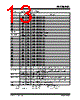








Okay, let's break down the information provided from the PIC16F5x datasheet excerpt. Here's a summary of the key points, organized for clarity:
1. Architecture & Core Features
️· Harvard Architecture: The PIC16F5x uses a Harvard architecture, meaning it has separate memory spaces for program instructions and data. This enables fetching instructions and accessing data simultaneously, improving performance.
️· Pipelining: Instructions are fetched and executed in a pipelined manner. Fetching takes one cycle, while decoding and execution take another. This makes each instruction *appear* to execute in one cycle.
️· Clocking: The clock input (OSC1/CLKIN) is divided internally by 4 to create four non-overlapping quadrature clocks (Q1, Q2, Q3, Q4). These clocks drive the instruction cycle.
️· Program Counter (PC): The PC increments every Q1 cycle. Instructions are fetched during Q4 and decoded/executed during Q1-Q4 of the following cycle.
2. Instruction Cycle Breakdown
️· Q1: PC increments.
️· Q2: Data memory read (if needed).
️· Q3: Further execution of the instruction.
️· Q4: Instruction is fetched and latched into the instruction register, Data memory write (if needed).
3. Instruction Flow
️· Normal Execution: An instruction generally takes two clock cycles – one for fetch and one for execution. However, the pipelining makes it *appear* as one cycle to the programmer.
️· Branch/Jump Instructions (e.g., GOTO): These take *three* clock cycles. The first cycle fetches the new address, the second fetches the instruction at that address, and the third executes it.
4. Model Specifics (Variants: PIC16F59, PIC16F57, PIC16F54)
️· PIC16F59: Includes more I/O pins (RD0-RD7, RE4-RE7).
️· PIC16F57: Fewer pins.
️· PIC16F54: Fewer pins.
Key Takeaways for Programmers
️· Execution Speed: While the datasheet talks about pipelining and cycles, the practical effect is that instructions generally execute quickly.
️· Branching Overhead: Be aware that branching instructions (like `GOTO`) will incur a slightly higher execution overhead (one extra clock cycle) compared to sequential code.
️· Pin Availability: Select the appropriate PIC16F5x variant based on your project's I/O requirements.
Let me know if you have any more specific questions about this information!
1. Architecture & Core Features
️· Harvard Architecture: The PIC16F5x uses a Harvard architecture, meaning it has separate memory spaces for program instructions and data. This enables fetching instructions and accessing data simultaneously, improving performance.
️· Pipelining: Instructions are fetched and executed in a pipelined manner. Fetching takes one cycle, while decoding and execution take another. This makes each instruction *appear* to execute in one cycle.
️· Clocking: The clock input (OSC1/CLKIN) is divided internally by 4 to create four non-overlapping quadrature clocks (Q1, Q2, Q3, Q4). These clocks drive the instruction cycle.
️· Program Counter (PC): The PC increments every Q1 cycle. Instructions are fetched during Q4 and decoded/executed during Q1-Q4 of the following cycle.
2. Instruction Cycle Breakdown
️· Q1: PC increments.
️· Q2: Data memory read (if needed).
️· Q3: Further execution of the instruction.
️· Q4: Instruction is fetched and latched into the instruction register, Data memory write (if needed).
3. Instruction Flow
️· Normal Execution: An instruction generally takes two clock cycles – one for fetch and one for execution. However, the pipelining makes it *appear* as one cycle to the programmer.
️· Branch/Jump Instructions (e.g., GOTO): These take *three* clock cycles. The first cycle fetches the new address, the second fetches the instruction at that address, and the third executes it.
4. Model Specifics (Variants: PIC16F59, PIC16F57, PIC16F54)
️· PIC16F59: Includes more I/O pins (RD0-RD7, RE4-RE7).
️· PIC16F57: Fewer pins.
️· PIC16F54: Fewer pins.
Key Takeaways for Programmers
️· Execution Speed: While the datasheet talks about pipelining and cycles, the practical effect is that instructions generally execute quickly.
️· Branching Overhead: Be aware that branching instructions (like `GOTO`) will incur a slightly higher execution overhead (one extra clock cycle) compared to sequential code.
️· Pin Availability: Select the appropriate PIC16F5x variant based on your project's I/O requirements.
| Part No. | PIC16F5X |
| Manufacturer | MICROCHIP |
| Size | 1Mb |
| Pages | 88 pages |
| Description | Flash-Based, 8-Bit CMOS Microcontroller Series |
| ALLDATASHEET é útil para você? [ DONATE ] |
Sobre Alldatasheet | Publicidade | Contato conosco | Privacy Policy | Link para a ficha técnica | roca de Link | Lista de Fabricantes All Rights Reserved©Alldatasheet.com |
| Russian : Alldatasheetru.com | Korean : Alldatasheet.co.kr | Spanish : Alldatasheet.es | French : Alldatasheet.fr | Italian : Alldatasheetit.com Portuguese : Alldatasheetpt.com | Polish : Alldatasheet.pl | Vietnamese : Alldatasheet.vn Indian : Alldatasheet.in | Mexican : Alldatasheet.com.mx | British : Alldatasheet.co.uk | New Zealand : Alldatasheet.co.nz |
|
Family Site : ic2ic.com |
icmetro.com |
 Portuguese ▼
  English
 Chinese
 German
 Japanese
 Russian
 Korean
 Spanish
 French
 Italian
 Polish
 Vietnamese
 Indian
 Mexican
 British
 New Zealand