 |
Os motores de busca de Datasheet de Componentes eletrônicos |
|
|
Os motores de busca de Datasheet de Componentes eletrônicos |
|
The question interval is too short.
Please try again in a few seconds.

Hello, Please ask a question about LTC3602 Datasheet
# Example questions:
➢ What is the typical output voltage range for optimized on-time operation, as mentioned in note 4?
➢ How does the efficiency change as the load current increases in burst mode operation?
➢ What is the recommended operating temperature range, based on the reference voltage vs temperature graph?
| Part No. | LTC3602 |
| Manufacturer | LINER |
| Size | 637 Kbytes |
| Pages | 28 pages |
| Description | Dual Channel 3A, 20V Monolithic Synchronous Step-Down Regulator |









1. Overview:
️· Device: LTC3633 is a synchronous buck-boost DC/DC converter. This means it can generate an output voltage that's either higher or lower than the input voltage, a useful feature for systems with fluctuating input sources.
️· Function: It converts a DC input voltage to a regulated DC output voltage.
️· Modes: It supports both Forced Continuous Mode (higher efficiency at heavier loads) and Burst Mode Operation (very high efficiency at light loads, and lower quiescent current).
️· Target Applications: The document doesn't explicitly state application, but implied target applications are power systems where output voltage needs to be regulated, even if input voltage is not constant, and/or efficiency is critical.
2. Key Features (Inferred from the document - not explicitly listed, but can be determined)
️· Buck-Boost Topology: Output voltage can be higher or lower than the input.
️· Synchronous Operation: Uses internal MOSFETs instead of diodes for increased efficiency.
️· Adjustable Output Voltage: The output voltage is likely adjustable through external components (not detailed in this excerpt).
️· Forced Continuous/Burst Mode: Optimizes efficiency across a wide range of loads.
️· Internal Compensation: Implies the converter has built-in circuitry to ensure stability.
️· Temperature Compensation: The oscillator frequency is compensated for temperature changes, ensuring a stable switching frequency.
️· Adjustable Switching Frequency: The switching frequency can be adjusted through external components.
️· Internal Set Frequency: The frequency is internally set, implying some degree of programmability or user control.
3. Electrical Characteristics (Extracted from the table - limited by the excerpt)
️· The excerpt doesn's contain a comprehensive electrical characteristics table. The main things that can be inferred are likely adjustable parameters.
4. Typical Performance Charts (Most Important - Summarized)
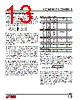
️· Efficiency vs. Load Current (Forced Continuous & Burst Mode): Shows efficiency curves for different output voltages. Efficiency is high over a wide range of loads, but drops at very light loads in Forced Continuous Mode and at heavy loads in Burst Mode.
️· Efficiency vs. Input Voltage: Illustrates how efficiency varies with input voltage, indicating a range of acceptable input voltages for optimal efficiency.
️· Reference Voltage vs. Temperature: Shows how the internal reference voltage changes with temperature. This is important for temperature compensation of the output voltage.
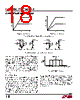
️· Oscillator Frequency vs. Temperature: The switching frequency is fairly stable with temperature.
️· Oscillator Internal Set Frequency vs. Temperature: Shows the set frequency vs temperature - implying this frequency can be adjusted.
️· Load Regulation: Shows how much the output voltage changes with load current.
️· Transient Response: (Not shown, but implied) The charts suggest the converter has a reasonable transient response.
5. Important Notes & Considerations (Extracted from text annotations)
️· Burst Mode Operation: Provides high efficiency at light loads but can have lower efficiency at higher loads.
️· Forced Continuous Mode: Better efficiency at heavier loads but higher quiescent current than Burst Mode at light loads.
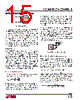
️· Output Voltage Range: Output voltages outside the specified range are not optimized for controlled on-time operation.
️· Overtemperature Protection: Intended to protect the device during momentary overload. Continuous operation above the maximum operating junction temperature *will* impair reliability.
️· Switching Frequency: There's mention of an "internally set frequency" and external components allowing for adjustment.
To give a more comprehensive response, I would need the full data sheet. However, this detailed summary captures the critical information from the excerpt provided.
1. Overview:
️· Device: LTC3633 is a synchronous buck-boost DC/DC converter. This means it can generate an output voltage that's either higher or lower than the input voltage, a useful feature for systems with fluctuating input sources.
️· Function: It converts a DC input voltage to a regulated DC output voltage.
️· Modes: It supports both Forced Continuous Mode (higher efficiency at heavier loads) and Burst Mode Operation (very high efficiency at light loads, and lower quiescent current).
️· Target Applications: The document doesn't explicitly state application, but implied target applications are power systems where output voltage needs to be regulated, even if input voltage is not constant, and/or efficiency is critical.
2. Key Features (Inferred from the document - not explicitly listed, but can be determined)
️· Buck-Boost Topology: Output voltage can be higher or lower than the input.
️· Synchronous Operation: Uses internal MOSFETs instead of diodes for increased efficiency.
️· Adjustable Output Voltage: The output voltage is likely adjustable through external components (not detailed in this excerpt).
️· Forced Continuous/Burst Mode: Optimizes efficiency across a wide range of loads.
️· Internal Compensation: Implies the converter has built-in circuitry to ensure stability.
️· Temperature Compensation: The oscillator frequency is compensated for temperature changes, ensuring a stable switching frequency.
️· Adjustable Switching Frequency: The switching frequency can be adjusted through external components.
️· Internal Set Frequency: The frequency is internally set, implying some degree of programmability or user control.
3. Electrical Characteristics (Extracted from the table - limited by the excerpt)
️· The excerpt doesn's contain a comprehensive electrical characteristics table. The main things that can be inferred are likely adjustable parameters.
4. Typical Performance Charts (Most Important - Summarized)
️· Efficiency vs. Load Current (Forced Continuous & Burst Mode): Shows efficiency curves for different output voltages. Efficiency is high over a wide range of loads, but drops at very light loads in Forced Continuous Mode and at heavy loads in Burst Mode.
️· Efficiency vs. Input Voltage: Illustrates how efficiency varies with input voltage, indicating a range of acceptable input voltages for optimal efficiency.
️· Reference Voltage vs. Temperature: Shows how the internal reference voltage changes with temperature. This is important for temperature compensation of the output voltage.
️· Oscillator Frequency vs. Temperature: The switching frequency is fairly stable with temperature.
️· Oscillator Internal Set Frequency vs. Temperature: Shows the set frequency vs temperature - implying this frequency can be adjusted.
️· Load Regulation: Shows how much the output voltage changes with load current.
️· Transient Response: (Not shown, but implied) The charts suggest the converter has a reasonable transient response.
5. Important Notes & Considerations (Extracted from text annotations)
️· Burst Mode Operation: Provides high efficiency at light loads but can have lower efficiency at higher loads.
️· Forced Continuous Mode: Better efficiency at heavier loads but higher quiescent current than Burst Mode at light loads.
️· Output Voltage Range: Output voltages outside the specified range are not optimized for controlled on-time operation.
️· Overtemperature Protection: Intended to protect the device during momentary overload. Continuous operation above the maximum operating junction temperature *will* impair reliability.
️· Switching Frequency: There's mention of an "internally set frequency" and external components allowing for adjustment.
To give a more comprehensive response, I would need the full data sheet. However, this detailed summary captures the critical information from the excerpt provided.
| Part No. | LTC3602 |
| Manufacturer | LINER |
| Size | 637 Kbytes |
| Pages | 28 pages |
| Description | Dual Channel 3A, 20V Monolithic Synchronous Step-Down Regulator |
| ALLDATASHEET é útil para você? [ DONATE ] |
Sobre Alldatasheet | Publicidade | Contato conosco | Privacy Policy | Link para a ficha técnica | roca de Link | Lista de Fabricantes All Rights Reserved©Alldatasheet.com |
| Russian : Alldatasheetru.com | Korean : Alldatasheet.co.kr | Spanish : Alldatasheet.es | French : Alldatasheet.fr | Italian : Alldatasheetit.com Portuguese : Alldatasheetpt.com | Polish : Alldatasheet.pl | Vietnamese : Alldatasheet.vn Indian : Alldatasheet.in | Mexican : Alldatasheet.com.mx | British : Alldatasheet.co.uk | New Zealand : Alldatasheet.co.nz |
|
Family Site : ic2ic.com |
icmetro.com |
 Portuguese ▼
  English
 Chinese
 German
 Japanese
 Russian
 Korean
 Spanish
 French
 Italian
 Polish
 Vietnamese
 Indian
 Mexican
 British
 New Zealand