 |
Os motores de busca de Datasheet de Componentes eletrônicos |
|
|
Os motores de busca de Datasheet de Componentes eletrônicos |
|
The question interval is too short.
Please try again in a few seconds.

Hello, Please ask a question about RF2492 Datasheet
# Example questions:
➢ How does the mixer rf amplifier current change between the 'on' and 'off' states, and what might be the reason for the difference?
➢ What is the typical supply voltage for this rf module?
➢ Compare the input ip3 performance with the lna 'on' and 'off' in the cellular band.
| Part No. | RF2492 |
| Manufacturer | RFMD |
| Size | 483 Kbytes |
| Pages | 22 pages |
| Description | DUAL-BAND LOW NOISE AMPLIFIER/MIXER |













1. Overview
️· Device: An RF receiver/front-end module (likely for use in cell phones or similar devices).
️· Frequency Bands: Designed to operate in both Cellular (850/900 MHz) and PCS (1900 MHz) frequency bands.
️· Key Components: Includes a Low-Noise Amplifier (LNA) and a Mixer.
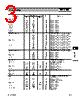
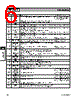
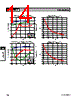
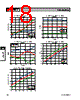
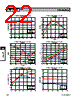
️· Performance Metrics: The datasheet details performance characteristics like Gain, Noise Figure, Input Third-Order Intercept Point (IIP3), and current consumption.
️· Configurations: Performance is reported for different configurations:
- LNA On vs. LNA Off
- LNA set to Max IIP3 vs. Nominal IIP3
- Mixer RF Amplifier (RFamp) On vs. Off
2. Key Performance Parameters (Typical Values)
️· Gain:
- Cellular (LNA On, Max IIP3, Mixer On): ~24.3 dB
- PCS (LNA On, Max IIP3, Mixer On): ~24.3 dB
️· Noise Figure:
- Cellular (LNA On, Max IIP3, Mixer On): ~2.6 dB
- PCS (LNA On, Max IIP3, Mixer On): ~2.6 dB
️· IIP3: (A measure of linearity - higher is better) IIP3 values are in the +14 dBm to +25 dBm range depending on the configuration
️· Supply Voltage: 2.7V - 3.6V
️· Current Consumption: Varies significantly based on configuration, ranging from approximately 26mA to 42.5mA.
3. Detailed Breakdown by Section
️· Mixer Isolation: Measures how well the mixer prevents signals from leaking between different ports. Typical values are in the 33-63 dB range.
️· Cascade Performance: Represents the combined performance of the LNA and Mixer. Provides Gain, Noise Figure, and IIP3 for various configurations.
️· Power Supply: Specifies the supply voltage range and the current draw under different operating conditions.
4. Important Considerations
️· Configuration Matters: The performance parameters are heavily dependent on the LNA and Mixer settings.
️· Linearity (IIP3): Higher IIP3 values indicate better linearity and less distortion, which is crucial for reliable signal reception.
️· Low Noise (Noise Figure): A low Noise Figure is essential for maximizing signal-to-noise ratio and improving sensitivity.
️· Isolation: Good isolation is important for preventing interference and ensuring accurate signal processing.
️· Focus on a specific parameter.
️· Compare performance between different configurations.
️· Help interpret a particular section of the datasheet.
1. Overview
️· Device: An RF receiver/front-end module (likely for use in cell phones or similar devices).
️· Frequency Bands: Designed to operate in both Cellular (850/900 MHz) and PCS (1900 MHz) frequency bands.
️· Key Components: Includes a Low-Noise Amplifier (LNA) and a Mixer.
️· Performance Metrics: The datasheet details performance characteristics like Gain, Noise Figure, Input Third-Order Intercept Point (IIP3), and current consumption.
️· Configurations: Performance is reported for different configurations:
- LNA On vs. LNA Off
- LNA set to Max IIP3 vs. Nominal IIP3
- Mixer RF Amplifier (RFamp) On vs. Off
2. Key Performance Parameters (Typical Values)
️· Gain:
- Cellular (LNA On, Max IIP3, Mixer On): ~24.3 dB
- PCS (LNA On, Max IIP3, Mixer On): ~24.3 dB
️· Noise Figure:
- Cellular (LNA On, Max IIP3, Mixer On): ~2.6 dB
- PCS (LNA On, Max IIP3, Mixer On): ~2.6 dB
️· IIP3: (A measure of linearity - higher is better) IIP3 values are in the +14 dBm to +25 dBm range depending on the configuration
️· Supply Voltage: 2.7V - 3.6V
️· Current Consumption: Varies significantly based on configuration, ranging from approximately 26mA to 42.5mA.
3. Detailed Breakdown by Section
️· Mixer Isolation: Measures how well the mixer prevents signals from leaking between different ports. Typical values are in the 33-63 dB range.
️· Cascade Performance: Represents the combined performance of the LNA and Mixer. Provides Gain, Noise Figure, and IIP3 for various configurations.
️· Power Supply: Specifies the supply voltage range and the current draw under different operating conditions.
4. Important Considerations
️· Configuration Matters: The performance parameters are heavily dependent on the LNA and Mixer settings.
️· Linearity (IIP3): Higher IIP3 values indicate better linearity and less distortion, which is crucial for reliable signal reception.
️· Low Noise (Noise Figure): A low Noise Figure is essential for maximizing signal-to-noise ratio and improving sensitivity.
️· Isolation: Good isolation is important for preventing interference and ensuring accurate signal processing.
️· Focus on a specific parameter.
️· Compare performance between different configurations.
️· Help interpret a particular section of the datasheet.
| Part No. | RF2492 |
| Manufacturer | RFMD |
| Size | 483 Kbytes |
| Pages | 22 pages |
| Description | DUAL-BAND LOW NOISE AMPLIFIER/MIXER |
| ALLDATASHEET é útil para você? [ DONATE ] |
Sobre Alldatasheet | Publicidade | Contato conosco | Privacy Policy | Link para a ficha técnica | roca de Link | Lista de Fabricantes All Rights Reserved©Alldatasheet.com |
| Russian : Alldatasheetru.com | Korean : Alldatasheet.co.kr | Spanish : Alldatasheet.es | French : Alldatasheet.fr | Italian : Alldatasheetit.com Portuguese : Alldatasheetpt.com | Polish : Alldatasheet.pl | Vietnamese : Alldatasheet.vn Indian : Alldatasheet.in | Mexican : Alldatasheet.com.mx | British : Alldatasheet.co.uk | New Zealand : Alldatasheet.co.nz |
|
Family Site : ic2ic.com |
icmetro.com |
 Portuguese ▼
  English
 Chinese
 German
 Japanese
 Russian
 Korean
 Spanish
 French
 Italian
 Polish
 Vietnamese
 Indian
 Mexican
 British
 New Zealand