 |
Os motores de busca de Datasheet de Componentes eletrônicos |
|
|
Os motores de busca de Datasheet de Componentes eletrônicos |
|
The question interval is too short.
Please try again in a few seconds.

Hello, Please ask a question about AD9767 Datasheet
# Example questions:
➢ The datasheet specifies a thermal resistance (θja) for the 48-lead lqfp package. what is this value and what does it indicate about the package's heat dissipation capabilities?
➢ The document details several error specifications like 'offset error' and 'gain error'. explain the difference between these two error types in the context of a dac like the ad9767.
➢ What is the primary purpose of the 'sleep' pin and what effect does activating it have on the device?
| Part No. | AD9767 |
| Manufacturer | AD |
| Size | 469 Kbytes |
| Pages | 27 pages |
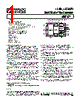
| Description | 14-Bit, 125 MSPS Dual TxDAC+ D/A Converter |






1. Overview & Purpose
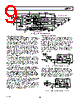
️· The AD9767 is a dual, 14-bit current output Digital-to-Analog Converter (DAC).
️· It's designed for applications requiring high accuracy, low noise, and flexibility. These include: portable audio, industrial control, data acquisition, and test equipment.
2. Key Features
️· Dual 14-bit DACs: Two independent DACs in a single chip.
️· High Accuracy: Focuses on linearity and minimal error.
️· Current Output: Outputs current, allowing for flexible gain and impedance matching.
️· Flexible Configuration: Supports dual-port or interleaved operation.
️· Adjustable Full-Scale Range: FSADJ1 and FSADJ2 pins allow adjustment of the output current range.
️· GAINCTRL: Provides a selectable gain.
️· Low Noise: Designed for low-noise performance.
️· Power Supply Flexibility: Operates with various power supply voltages.
3. Specifications
️· Resolution: 14 bits
️· Temperature Range: -40°C to +85°C
️· Power Supply Voltages: Specified voltage ranges (See datasheet for details)
️· Output Compliance: Ranges for acceptable voltage at output.
️· Linearity Error: Defined and targeted for high accuracy.
️· Differential Nonlinearity (DNL): Measures variation in output with code changes.
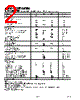
️· Offset Error: Deviation from zero output.
️· Gain Error: Difference between ideal and actual output span.
️· Power Supply Rejection: Measures performance under supply voltage changes.
️· Settling Time: Time for output to stabilize.
️· Glitch Impulse: Area of undesired output transients.
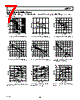
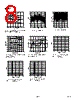
️· Spurious-Free Dynamic Range: Measurement of signal quality.
️· Total Harmonic Distortion (THD): A measure of signal distortion.
4. Pin Descriptions
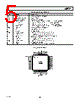
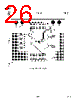
️· PORT1 & PORT2: Data input bits (DB13-P1 to DB0-P1 and DB13-P2 to DB0-P2).
️· DCOM1 & DCOM2: Digital Common.
️· DVDD1 & DVDD2: Digital Supply Voltage.
️· WRT1/IQWRT, WRT2/IQSEL: Write signals for data input.
️· CLK1/IQCLK, CLK2/IQRESET: Clock input.
️· SLEEP: Power-down control.
️· ACOM: Analog Common.
️· IOUTA2, IOUTB2 & IOUTA1, IOUTB1: Differential current outputs.
️· FSADJ2 & FSADJ1: Full-scale adjustment.
️· REFIO: Reference input/output.
️· GAINCTRL: Mode selection for gain.
️· MODE: Mode selection (dual port or interleaved)
5. Operational Configurations
️· Dual-Port Mode: Each DAC operates independently.
️· Interleaved Mode: Data is sent to both DACs simultaneously, useful for higher data rates.
6. Test Setup Diagram
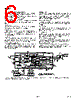
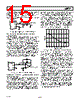
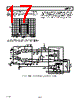
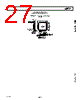
️· Figure 2 shows a basic setup for characterizing the AC performance of Port 1 in dual port mode.
7. Important Notes
️· ESD Sensitivity: The AD9767 is sensitive to Electrostatic Discharge (ESD) and requires handling precautions.
️· Thermal Resistance: Specifications are provided for thermal management.
1. Overview & Purpose
️· The AD9767 is a dual, 14-bit current output Digital-to-Analog Converter (DAC).
️· It's designed for applications requiring high accuracy, low noise, and flexibility. These include: portable audio, industrial control, data acquisition, and test equipment.
2. Key Features
️· Dual 14-bit DACs: Two independent DACs in a single chip.
️· High Accuracy: Focuses on linearity and minimal error.
️· Current Output: Outputs current, allowing for flexible gain and impedance matching.
️· Flexible Configuration: Supports dual-port or interleaved operation.
️· Adjustable Full-Scale Range: FSADJ1 and FSADJ2 pins allow adjustment of the output current range.
️· GAINCTRL: Provides a selectable gain.
️· Low Noise: Designed for low-noise performance.
️· Power Supply Flexibility: Operates with various power supply voltages.
3. Specifications
️· Resolution: 14 bits
️· Temperature Range: -40°C to +85°C
️· Power Supply Voltages: Specified voltage ranges (See datasheet for details)
️· Output Compliance: Ranges for acceptable voltage at output.
️· Linearity Error: Defined and targeted for high accuracy.
️· Differential Nonlinearity (DNL): Measures variation in output with code changes.
️· Offset Error: Deviation from zero output.
️· Gain Error: Difference between ideal and actual output span.
️· Power Supply Rejection: Measures performance under supply voltage changes.
️· Settling Time: Time for output to stabilize.
️· Glitch Impulse: Area of undesired output transients.
️· Spurious-Free Dynamic Range: Measurement of signal quality.
️· Total Harmonic Distortion (THD): A measure of signal distortion.
4. Pin Descriptions
️· PORT1 & PORT2: Data input bits (DB13-P1 to DB0-P1 and DB13-P2 to DB0-P2).
️· DCOM1 & DCOM2: Digital Common.
️· DVDD1 & DVDD2: Digital Supply Voltage.
️· WRT1/IQWRT, WRT2/IQSEL: Write signals for data input.
️· CLK1/IQCLK, CLK2/IQRESET: Clock input.
️· SLEEP: Power-down control.
️· ACOM: Analog Common.
️· IOUTA2, IOUTB2 & IOUTA1, IOUTB1: Differential current outputs.
️· FSADJ2 & FSADJ1: Full-scale adjustment.
️· REFIO: Reference input/output.
️· GAINCTRL: Mode selection for gain.
️· MODE: Mode selection (dual port or interleaved)
5. Operational Configurations
️· Dual-Port Mode: Each DAC operates independently.
️· Interleaved Mode: Data is sent to both DACs simultaneously, useful for higher data rates.
6. Test Setup Diagram
️· Figure 2 shows a basic setup for characterizing the AC performance of Port 1 in dual port mode.
7. Important Notes
️· ESD Sensitivity: The AD9767 is sensitive to Electrostatic Discharge (ESD) and requires handling precautions.
️· Thermal Resistance: Specifications are provided for thermal management.
| Part No. | AD9767 |
| Manufacturer | AD |
| Size | 469 Kbytes |
| Pages | 27 pages |
| Description | 14-Bit, 125 MSPS Dual TxDAC+ D/A Converter |
| ALLDATASHEET é útil para você? [ DONATE ] |
Sobre Alldatasheet | Publicidade | Contato conosco | Privacy Policy | Link para a ficha técnica | roca de Link | Lista de Fabricantes All Rights Reserved©Alldatasheet.com |
| Russian : Alldatasheetru.com | Korean : Alldatasheet.co.kr | Spanish : Alldatasheet.es | French : Alldatasheet.fr | Italian : Alldatasheetit.com Portuguese : Alldatasheetpt.com | Polish : Alldatasheet.pl | Vietnamese : Alldatasheet.vn Indian : Alldatasheet.in | Mexican : Alldatasheet.com.mx | British : Alldatasheet.co.uk | New Zealand : Alldatasheet.co.nz |
|
Family Site : ic2ic.com |
icmetro.com |
 Portuguese ▼
  English
 Chinese
 German
 Japanese
 Russian
 Korean
 Spanish
 French
 Italian
 Polish
 Vietnamese
 Indian
 Mexican
 British
 New Zealand