|
Os motores de busca de Datasheet de Componentes eletrônicos |
|
|
Os motores de busca de Datasheet de Componentes eletrônicos |
|
AD9764ARZ Folha de dados(PDF) 16 Page - Analog Devices |
|
|
|||||||||||||||||||||||||||||
AD9764ARZ Folha de dados(HTML) 16 Page - Analog Devices |
|
|
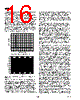
16 / 22 page  REV. B AD9764 –16– MULTITONE PERFORMANCE CONSIDERATIONS AND CHARACTERIZATION The frequency domain performance of high speed DACs has traditionally been characterized by analyzing the spectral output of a reconstructed full-scale (i.e., 0 dBFS), single-tone sine wave at a particular output frequency and update rate. Although this characterization data is useful, it is often insufficient to reflect a DAC’s performance for a reconstructed multitone or spread- spectrum waveform. In fact, evaluating a DAC’s spectral performance using a full-scale, single tone at the highest specified frequency (i.e., fH) of a bandlimited waveform is typically indicative of a DAC’s “worst-case” performance for that given waveform. In the time domain, this full-scale sine wave repre- sents the lowest peak-to-rms ratio or crest factor (i.e., VPEAK/V rms) that this bandlimited signal will encounter. FREQUENCY – MHz –10 –70 –110 2.19 2.81 2.25 2.31 2.38 2.44 2.50 2.56 2.63 2.69 2.75 –20 –60 –80 –100 –40 –50 –90 –30 Figure 39a. Multitone Spectral Plot TIME 1.0000 0.8000 –1.0000 –0.2000 –0.4000 –0.6000 –0.8000 0.2000 0.0000 0.4000 0.6000 Figure 39b. Time Domain “Snapshot” of the Multitone Waveform However, the inherent nature of a multitone, spread spectrum, or QAM waveform, in which the spectral energy of the wave- form is spread over a designated bandwidth, will result in a higher peak-to-rms ratio when compared to the case of a simple sine wave. As the reconstructed waveform’s peak-to-average ratio increases, an increasing amount of the signal energy is concentrated around the DAC’s midscale value. Figure 39a is just one example of a bandlimited multitone vector (i.e., eight tones) centered around one-half the Nyquist bandwidth (i.e., fCLOCK/4). This particular multitone vector, has a peak-to-rms ratio of 13.5 dB compared to a sine waves peak-to-rms ratio of 3 dB. A “snapshot” of this reconstructed multitone vector in the time domain as shown in Figure 39b reveals the higher signal content around the midscale value. As a result, a DAC’s “small-scale” dynamic and static linearity becomes increas- ingly critical in obtaining low intermodulation distortion and maintaining sufficient carrier-to-noise ratios for a given modula- tion scheme. A DAC’s small-scale linearity performance is also an important consideration in applications where additive dynamic range is required for gain control purposes or “predistortion” signal conditioning. For instance, a DAC with sufficient dynamic range can be used to provide additional gain control of its reconstructed signal. In fact, the gain can be controlled in 6 dB increments by simply performing a shift left or right on the DAC’s digital input word. Other applications may intentionally predistort a DAC’s digital input signal to compensate for nonlinearities associated with the subsequent analog compo- nents in the signal chain. For example, the signal compression associated with a power amplifier can be compensated for by predistorting the DAC’s digital input with the inverse nonlinear transfer function of the power amplifier. In either case, the DAC’s performance at reduced signal levels should be carefully evaluated. A full-scale single tone will induce all of the dynamic and static nonlinearities present in a DAC that contribute to its distortion and hence SFDR performance. Referring to Figure 3, as the frequency of this reconstructed full-scale, single-tone waveform increases, the dynamic nonlinearities of any DAC (i.e., AD9764) tend to dominate thus contributing to the rolloff in its SFDR performance. However, unlike most DACs, which employ an R-2R ladder for the lower bit current segmentation, the AD9764 (as well as other TxDAC members) exhibits an improvement in distortion performance as the amplitude of a single tone is re- duced from its full-scale level. This improvement in distortion performance at reduced signal levels is evident if one compares the SFDR performance vs. frequency at different amplitudes (i.e., 0 dBFS, –6 dBFS and –12 dBFS) and sample rates as shown in Figures 4 through 7. Maintaining decent “small-scale” linearity across the full span of a DAC transfer function is also critical in maintaining excellent multitone performance. Although characterizing a DAC’s multitone performance tends to be application-specific, much insight into the potential per- formance of a DAC can also be gained by evaluating the DAC’s swept power (i.e., amplitude) performance for single, dual and multitone test vectors at different clock rates and carrier frequen- cies. The DAC is evaluated at different clock rates when recon- structing a specific waveform whose amplitude is decreased in 3 dB increments from full-scale (i.e., 0 dBFS). For each specific waveform, a graph showing the SFDR (over Nyquist) perfor- mance vs. amplitude can be generated at the different tested clock rates as shown in Figures 9–11. Note that the carrier(s)- to-clock ratio remains constant in each figure. In each case, an improvement in SFDR performance is seen as the amplitude is reduced from 0 dBFS to approximately –9.0 dBFS. A multitone test vector may consist of several equal amplitude, spaced carriers each representative of a channel within a defined bandwidth as shown in Figure 39a. In many cases, one or more tones are removed so the intermodulation distortion performance |
|
|
Ligação URL |
| ALLDATASHEET é útil para você? [ DONATE ] |
Sobre Alldatasheet | Publicidade | Contato conosco | Privacy Policy | Link para a ficha técnica | roca de Link | Lista de Fabricantes All Rights Reserved©Alldatasheet.com |
| Russian : Alldatasheetru.com | Korean : Alldatasheet.co.kr | Spanish : Alldatasheet.es | French : Alldatasheet.fr | Italian : Alldatasheetit.com Portuguese : Alldatasheetpt.com | Polish : Alldatasheet.pl | Vietnamese : Alldatasheet.vn Indian : Alldatasheet.in | Mexican : Alldatasheet.com.mx | British : Alldatasheet.co.uk | New Zealand : Alldatasheet.co.nz |
|
Family Site : ic2ic.com |
icmetro.com |
 Portuguese ▼
 English
 Chinese
 German
 Japanese
 Russian
 Korean
 Spanish
 French
 Italian
 Portuguese
 Polish
 Vietnamese
 Indian
 Mexican
 British
 New Zealand