|
Os motores de busca de Datasheet de Componentes eletrônicos |
|
|
Os motores de busca de Datasheet de Componentes eletrônicos |
|
PIC16F690 Folha de dados(PDF) 2 Page - Microchip Technology |
|
|
|||||||||||||||||||||||||||||
PIC16F690 Folha de dados(HTML) 2 Page - Microchip Technology |
|
|
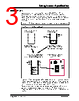
2 / 78 page  Debug Header Specification DS51292T-page 2 2006-2012 Microchip Technology Inc. WHY DO I NEED A HEADER TO DEBUG? Some PIC® microcontrollers, particularly low pin count devices (with 20 pins or less), generally must use a header for debugging. This is done to free up I/O lines for your application and to make production parts more affordable. Optional headers are also available for high pin count devices (with 64 pins or higher). Debugging requires a two-line connection (plus VDD, VSS and VPP) to communicate with the device. In a high pin count device, losing a few I/O lines is generally not a prob- lem for most designs. But in a low pin count device, it can be a critical problem. Imagine having to do an 8-pin design where there are only 5 I/Os, having used up 2 I/Os just for debugging! Headers are also used to save you money. In high pin count devices, adding debugging to the silicon can generally be done at little or no cost since the silicon is already fairly large. However, low pin count devices are low cost specifically because they use very little silicon. So, adding debugging circuitry on-board these parts would add significant cost since it would raise the amount of silicon used by a considerable percentage. The header places the cost for debugging up front and frees your production parts from the extra cost of an unused debug module. Microchip also makes optional debug modules, usually for high pin count devices. The module is optional because you can still do basic debugging without a header, but if you use one, you get back I/O lines, and may also gain additional debugging features. Only certain devices can use an optional header, see the device page on our website for details. Microchip lists what header must be ordered to work with your device, if one is required. Simply consult the device page on our website, or our other ordering guides. Note that in all cases, devices can be programmed “in circuit” (called ICSP™) with very few exceptions. Even devices without an internal debug feature can still be pro- grammed by connecting the programming/debugging tool to the in-circuit programming lines. These devices simply cannot perform debugging without a header. FIGURE 1: PRODUCTION DEVICE VS. HEADER DEVICE (-ICE/-ICD) ENABLE ICDMCLR VDD ICDCLK ICDDATA Vss ICD NC 1 2 3 4 5 6 7 20 19 18 17 16 15 14 JP1 2 1 3 VDD To Tool Connector 8 9 10 11 12 13 VDD Vss 1 2 3 4 5 6 7 14 13 12 11 10 9 8 -ICE/ICD Device on Debug Header Production Device |
|
Ligação URL |
| ALLDATASHEET é útil para você? [ DONATE ] |
Sobre Alldatasheet | Publicidade | Contato conosco | Privacy Policy | Link para a ficha técnica | roca de Link | Lista de Fabricantes All Rights Reserved©Alldatasheet.com |
| Russian : Alldatasheetru.com | Korean : Alldatasheet.co.kr | Spanish : Alldatasheet.es | French : Alldatasheet.fr | Italian : Alldatasheetit.com Portuguese : Alldatasheetpt.com | Polish : Alldatasheet.pl | Vietnamese : Alldatasheet.vn Indian : Alldatasheet.in | Mexican : Alldatasheet.com.mx | British : Alldatasheet.co.uk | New Zealand : Alldatasheet.co.nz |
|
Family Site : ic2ic.com |
icmetro.com |
 Portuguese ▼
 English
 Chinese
 German
 Japanese
 Russian
 Korean
 Spanish
 French
 Italian
 Portuguese
 Polish
 Vietnamese
 Indian
 Mexican
 British
 New Zealand