 |
Os motores de busca de Datasheet de Componentes eletrônicos |
|
|
Os motores de busca de Datasheet de Componentes eletrônicos |
|
The question interval is too short.
Please try again in a few seconds.

Hello, Please ask a question about LT8636 Datasheet
# Example questions:
➢ How does increasing the switching frequency (fsw) generally affect the efficiency of the lt8636/lt8637?
➢ What is the typical efficiency of the lt8636 when stepping down 12v to 5v at a load current of 2a?
➢ What is the purpose of burst mode operation as depicted in the graphs, and how does it affect the efficiency at very low load currents?
| Part No. | LT8636 |
| Manufacturer | AD |
| Size | 2Mb |
| Pages | 32 pages |
| Description | 42V, 5A/7A Peak Synchronous Step-Down Silent Switcher with 2.5關A Quiescent Current |


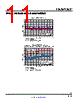


1. General Information
️· Product: LT8636/LT8637 (Synchronous Buck-Boost DC/DC Controllers)
️· Function: These are synchronous buck-boost controllers. Buck-boost converters can produce an output voltage that is higher, lower, or equal to the input voltage. This makes them very versatile.
️· Application: Suitable for a variety of power conversion applications.
2. Key Features (from the text - limited, but implied)
️· Synchronous: Use internal MOSFETs, improving efficiency compared to using external diodes.
️· Buck-Boost: Capable of handling input voltages above, below, or equal to the desired output voltage.
️· Burst Mode Operation: A power-saving mode that improves efficiency at light loads.
️· Overtemperature Protection: Protects the IC from overheating.
️· Adjustable Switching Frequency: Allows optimization for different applications.
️· Wide Input Voltage Range: Suitable for a variety of power sources.
3. Performance Characteristics (from the graphs - detailed analysis)
Let's analyze each of the graph descriptions (I'm trying to be as precise as possible). Please note that the images are not perfectly clear, so some interpretation is needed.
️· Efficiency vs Frequency (12V IN to 5V OUT): The graph shows efficiency varying with switching frequency (fSW). Generally, efficiency is higher at lower frequencies, but there's likely a trade-off with component size and response time. Specific numbers are hard to read precisely.
️· Efficiency vs Frequency (12V IN to 3.3V OUT): Similar to the previous graph, showing efficiency changes with frequency for a different output voltage.
️· Efficiency at 5V OUT: Shows a general trend of higher efficiency with higher load currents.
️· Low Load Efficiency at 5V OUT (LT8636 & LT8637): Both controllers have reduced efficiency at very light loads. Burst Mode Operation aims to improve this. The LT8636 performs slightly better than the LT8637 in this low load scenario.
️· Efficiency vs Frequency (LT8637): A graph showing the dependence of efficiency on frequency for the LT8637.
️· Low Load Efficiency at 3.3V OUT (LT8636 & LT8637): Shows performance at very low load currents for 3.3V output. Again, both controllers experience a drop in efficiency at light loads, highlighting the need for Burst Mode.
️· Burst Mode Operation: Graph depicting the relationship between load current and some metric (likely efficiency or power loss) during Burst Mode. It illustrates how Burst Mode allows the controller to maintain reasonable efficiency at very light loads.
4. Notes and Considerations (from text)
️· Overtemperature Protection: The IC has this protection, but exceeding the maximum operating junction temperature reduces lifetime.
️· Burst Mode Tradeoffs: While Burst Mode improves light-load efficiency, it may introduce some noise or instability.
️· Thermal Management: Important to consider thermal impedance and ensure proper heat sinking. The text provides JEDEC values for thermal impedance.
️· Efficiency vs. Load Current: The graphs clearly demonstrate that efficiency generally increases with load current.
️· Input Voltage: The graphs seem to be based on 12V, 24V and 36V Input.
Summary Table (Key Performance Parameters - approximate from graphs)
| Parameter | Condition | Approximate Value | Notes |
|---|---|---|---|
| Input Voltage | - | 12V-36V | Varying by test case. |
| Output Voltages | - | 5V, 3.3V | |
| Switching Frequency | - | Adjustable | Higher frequency = smaller components. |
| Efficiency (High Load) | 5V Out | 85-95% | Varies with frequency, input voltage |
| Efficiency (Light Load) | 5V Out | 50-70% | Burst Mode required. |
1. General Information
️· Product: LT8636/LT8637 (Synchronous Buck-Boost DC/DC Controllers)
️· Function: These are synchronous buck-boost controllers. Buck-boost converters can produce an output voltage that is higher, lower, or equal to the input voltage. This makes them very versatile.
️· Application: Suitable for a variety of power conversion applications.
2. Key Features (from the text - limited, but implied)
️· Synchronous: Use internal MOSFETs, improving efficiency compared to using external diodes.
️· Buck-Boost: Capable of handling input voltages above, below, or equal to the desired output voltage.
️· Burst Mode Operation: A power-saving mode that improves efficiency at light loads.
️· Overtemperature Protection: Protects the IC from overheating.
️· Adjustable Switching Frequency: Allows optimization for different applications.
️· Wide Input Voltage Range: Suitable for a variety of power sources.
3. Performance Characteristics (from the graphs - detailed analysis)
Let's analyze each of the graph descriptions (I'm trying to be as precise as possible). Please note that the images are not perfectly clear, so some interpretation is needed.
️· Efficiency vs Frequency (12V IN to 5V OUT): The graph shows efficiency varying with switching frequency (fSW). Generally, efficiency is higher at lower frequencies, but there's likely a trade-off with component size and response time. Specific numbers are hard to read precisely.
️· Efficiency vs Frequency (12V IN to 3.3V OUT): Similar to the previous graph, showing efficiency changes with frequency for a different output voltage.
️· Efficiency at 5V OUT: Shows a general trend of higher efficiency with higher load currents.
️· Low Load Efficiency at 5V OUT (LT8636 & LT8637): Both controllers have reduced efficiency at very light loads. Burst Mode Operation aims to improve this. The LT8636 performs slightly better than the LT8637 in this low load scenario.
️· Efficiency vs Frequency (LT8637): A graph showing the dependence of efficiency on frequency for the LT8637.
️· Low Load Efficiency at 3.3V OUT (LT8636 & LT8637): Shows performance at very low load currents for 3.3V output. Again, both controllers experience a drop in efficiency at light loads, highlighting the need for Burst Mode.
️· Burst Mode Operation: Graph depicting the relationship between load current and some metric (likely efficiency or power loss) during Burst Mode. It illustrates how Burst Mode allows the controller to maintain reasonable efficiency at very light loads.
4. Notes and Considerations (from text)
️· Overtemperature Protection: The IC has this protection, but exceeding the maximum operating junction temperature reduces lifetime.
️· Burst Mode Tradeoffs: While Burst Mode improves light-load efficiency, it may introduce some noise or instability.
️· Thermal Management: Important to consider thermal impedance and ensure proper heat sinking. The text provides JEDEC values for thermal impedance.
️· Efficiency vs. Load Current: The graphs clearly demonstrate that efficiency generally increases with load current.
️· Input Voltage: The graphs seem to be based on 12V, 24V and 36V Input.
Summary Table (Key Performance Parameters - approximate from graphs)
| Parameter | Condition | Approximate Value | Notes |
|---|---|---|---|
| Input Voltage | - | 12V-36V | Varying by test case. |
| Output Voltages | - | 5V, 3.3V | |
| Switching Frequency | - | Adjustable | Higher frequency = smaller components. |
| Efficiency (High Load) | 5V Out | 85-95% | Varies with frequency, input voltage |
| Efficiency (Light Load) | 5V Out | 50-70% | Burst Mode required. |
| Part No. | LT8636 |
| Manufacturer | AD |
| Size | 2Mb |
| Pages | 32 pages |
| Description | 42V, 5A/7A Peak Synchronous Step-Down Silent Switcher with 2.5關A Quiescent Current |
| ALLDATASHEET é útil para você? [ DONATE ] |
Sobre Alldatasheet | Publicidade | Contato conosco | Privacy Policy | Link para a ficha técnica | roca de Link | Lista de Fabricantes All Rights Reserved©Alldatasheet.com |
| Russian : Alldatasheetru.com | Korean : Alldatasheet.co.kr | Spanish : Alldatasheet.es | French : Alldatasheet.fr | Italian : Alldatasheetit.com Portuguese : Alldatasheetpt.com | Polish : Alldatasheet.pl | Vietnamese : Alldatasheet.vn Indian : Alldatasheet.in | Mexican : Alldatasheet.com.mx | British : Alldatasheet.co.uk | New Zealand : Alldatasheet.co.nz |
|
Family Site : ic2ic.com |
icmetro.com |
 Portuguese ▼
  English
 Chinese
 German
 Japanese
 Russian
 Korean
 Spanish
 French
 Italian
 Polish
 Vietnamese
 Indian
 Mexican
 British
 New Zealand