 |
Os motores de busca de Datasheet de Componentes eletrônicos |
|
|
Os motores de busca de Datasheet de Componentes eletrônicos |
|
The question interval is too short.
Please try again in a few seconds.

Hello, Please ask a question about LM4919 Datasheet
# Example questions:
➢ What is the primary function of the 'mute' feature in the lm4919, and under what conditions is it most effective (or unnecessary)?
➢ Describe how the selection of the input coupling capacitor (ci) impacts both low-frequency performance and turn-on time, and what value range is recommended for typical portable headphone applications?
➢ Explain the relationship between the bypass capacitor (cb) and the reduction of turn-on 'pops' or transients, and what capacitor value is suggested for optimal performance in conjunction with a small input capacitor (ci)?
| Part No. | LM4919 |
| Manufacturer | NSC |
| Size | 568 Kbytes |
| Pages | 15 pages |
| Description | 1.5V, Mono 85mW BTL Output, 14mW Stereo Headphone Audio Amplifier |


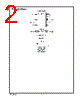

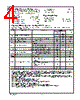


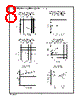


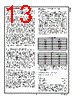


LM4919: Application and Design Considerations
1. General Operation & Modes
️· Micro-Power Shutdown: Reduces power consumption by turning off the amplifier's bias circuitry. Achieved by applying a logic-low signal to the SHUTDOWN pin.
️· Mute: Enables/disables the amplifier output signal quickly, minimizing "pops" and "clicks". Provides faster turn-on/turn-off than shutdown. In single-ended mode, it's the preferred method for silencing the amplifier. In BTL mode, it functions similarly to the shutdown feature.
️· Normal Operation: The LM4919 is unity-gain stable, allowing for design flexibility, but low gain configurations are recommended to minimize Total Harmonic Distortion + Noise (THD+N) and maximize signal-to-noise ratio.
2. Component Selection - Key Considerations
️· Input Coupling Capacitor (C<sub>i</sub>):
- Impacts low-frequency response.
- Larger capacitor = better low-frequency reproduction, but increases turn-on time and cost/size.
- Values between 0.1µF to 0.47µF are generally recommended, especially for headphones with limited low-frequency response.
️· Bypass Capacitor (C<sub>B</sub>):
- Connected to the BYPASS pin.
- Crucial for minimizing turn-on pops.
- A value of 4.7µF, in conjunction with a small C<sub>i</sub> (0.1µF - 0.47µF), is ideal for click/pop-free operation.
️· Gain-Setting Resistors (R<sub>i</sub> & R<sub>f</sub>):
- Keep values below 1MΩ to maintain stability and performance.
3. Minimizing Turn-On Pops and Clicks
️· Slow Settling Time: Allowing the amplifier outputs to ramp slowly to their quiescent DC voltage (V<sub>DD</sub> / 2) reduces pops and clicks.
️· Small Input Capacitor: A smaller C<sub>i</sub> helps reduce output transients when power is first applied or the LM4919 resumes operation.
️· Bypass Capacitor Value: Use 4.7µF C<sub>B</sub> to enable pop-free shutdown function.
4. Mute Considerations
️· High Impedance Loads: May require a parallel load resistance to achieve satisfactory mute levels.
️· Timing Periods (X1 & X2): Avoid toggling the Mute signal during these periods (especially after a shutdown transition) to prevent issues.
5. Specific Applications
️· Portable Systems: Considerations for space and cost are important when selecting component values.
️· Audio Codecs: Input signals from audio codecs are typically 1V RMS or greater.
Important Notes & Cautions
️· Proper Power Supply Bypassing: Essential for low noise performance and supply rejection. Place capacitors close to the device pins.
️· Timing Periods: Be aware of timing periods (X1 & X2) when controlling the mute function, particularly after a shutdown.
LM4919: Application and Design Considerations
1. General Operation & Modes
️· Micro-Power Shutdown: Reduces power consumption by turning off the amplifier's bias circuitry. Achieved by applying a logic-low signal to the SHUTDOWN pin.
️· Mute: Enables/disables the amplifier output signal quickly, minimizing "pops" and "clicks". Provides faster turn-on/turn-off than shutdown. In single-ended mode, it's the preferred method for silencing the amplifier. In BTL mode, it functions similarly to the shutdown feature.
️· Normal Operation: The LM4919 is unity-gain stable, allowing for design flexibility, but low gain configurations are recommended to minimize Total Harmonic Distortion + Noise (THD+N) and maximize signal-to-noise ratio.
2. Component Selection - Key Considerations
️· Input Coupling Capacitor (C<sub>i</sub>):
- Impacts low-frequency response.
- Larger capacitor = better low-frequency reproduction, but increases turn-on time and cost/size.
- Values between 0.1µF to 0.47µF are generally recommended, especially for headphones with limited low-frequency response.
️· Bypass Capacitor (C<sub>B</sub>):
- Connected to the BYPASS pin.
- Crucial for minimizing turn-on pops.
- A value of 4.7µF, in conjunction with a small C<sub>i</sub> (0.1µF - 0.47µF), is ideal for click/pop-free operation.
️· Gain-Setting Resistors (R<sub>i</sub> & R<sub>f</sub>):
- Keep values below 1MΩ to maintain stability and performance.
3. Minimizing Turn-On Pops and Clicks
️· Slow Settling Time: Allowing the amplifier outputs to ramp slowly to their quiescent DC voltage (V<sub>DD</sub> / 2) reduces pops and clicks.
️· Small Input Capacitor: A smaller C<sub>i</sub> helps reduce output transients when power is first applied or the LM4919 resumes operation.
️· Bypass Capacitor Value: Use 4.7µF C<sub>B</sub> to enable pop-free shutdown function.
4. Mute Considerations
️· High Impedance Loads: May require a parallel load resistance to achieve satisfactory mute levels.
️· Timing Periods (X1 & X2): Avoid toggling the Mute signal during these periods (especially after a shutdown transition) to prevent issues.
5. Specific Applications
️· Portable Systems: Considerations for space and cost are important when selecting component values.
️· Audio Codecs: Input signals from audio codecs are typically 1V RMS or greater.
Important Notes & Cautions
️· Proper Power Supply Bypassing: Essential for low noise performance and supply rejection. Place capacitors close to the device pins.
️· Timing Periods: Be aware of timing periods (X1 & X2) when controlling the mute function, particularly after a shutdown.
| Part No. | LM4919 |
| Manufacturer | NSC |
| Size | 568 Kbytes |
| Pages | 15 pages |
| Description | 1.5V, Mono 85mW BTL Output, 14mW Stereo Headphone Audio Amplifier |
| ALLDATASHEET é útil para você? [ DONATE ] |
Sobre Alldatasheet | Publicidade | Contato conosco | Privacy Policy | Link para a ficha técnica | roca de Link | Lista de Fabricantes All Rights Reserved©Alldatasheet.com |
| Russian : Alldatasheetru.com | Korean : Alldatasheet.co.kr | Spanish : Alldatasheet.es | French : Alldatasheet.fr | Italian : Alldatasheetit.com Portuguese : Alldatasheetpt.com | Polish : Alldatasheet.pl | Vietnamese : Alldatasheet.vn Indian : Alldatasheet.in | Mexican : Alldatasheet.com.mx | British : Alldatasheet.co.uk | New Zealand : Alldatasheet.co.nz |
|
Family Site : ic2ic.com |
icmetro.com |
 Portuguese ▼
  English
 Chinese
 German
 Japanese
 Russian
 Korean
 Spanish
 French
 Italian
 Polish
 Vietnamese
 Indian
 Mexican
 British
 New Zealand