 |
Os motores de busca de Datasheet de Componentes eletrônicos |
|
|
Os motores de busca de Datasheet de Componentes eletrônicos |
|
The question interval is too short.
Please try again in a few seconds.

Hello, Please ask a question about HT6032 Datasheet
# Example questions:
➢ What is the recommended relationship between the oscillator frequency of the encoder and the decoder?
➢ What type of components do these companies provide that are used in conjunction with the decoders?
➢ What is the primary function of the ht6030 decoder, and how does it differ from the ht6032?
| Part No. | HT6032 |
| Manufacturer | HOLTEK |
| Size | 106 Kbytes |
| Pages | 10 pages |
| Description | 312 Series of Decoders |



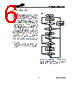


Okay, here's a breakdown and summarization of the provided document. It's a datasheet for the Holtek Semiconductor "3 [12] Series of Decoders." This is a fairly technical document, aimed at engineers using these components.
1. Overview:
️· Product: The Holtek 3 [12] Series of Decoders. These are integrated circuits (ICs) used to receive and decode signals, primarily in remote control and data transmission applications.
️· Function: They act as the receiver end of a communication system. They receive a signal, verify it matches a programmed address, and then activate corresponding output pins. They're designed to work with corresponding encoders (like the HT6010, HT6012, HT6014).
️· Typical Applications: Remote controls (infrared or radio frequency), data transmission systems.
️· Datasheet Purpose: Provides technical information to engineers for using the decoders in their designs.
2. Key Features and Specifications:
️· Address Decoding: The decoders compare the received signal to a predetermined address. Only if the addresses match is the data decoded and outputted.
️· Valid Transmission Indication: The "VT" (Valid Transmission) pin goes high only when a valid transmission is received. This indicates a successful decoding.
️· Data Latching: The data outputs are latched and remain in that state until the next valid transmission.
️· Oscillator Frequency: There are recommendations and dependencies on oscillator frequency, tying the decoder’s frequency to the encoder’s.
️· Variety of Models: Different models (HT6030, HT6032, HT6034, etc.) cater to different numbers of address and data pins, giving flexibility in system design.
️· Address/Data Arrangement: The datasheet provides tables specifying the arrangement of address and data pins for each model.
3. Detailed Sections (with key takeaways):
️· Electrical Characteristics: Includes typical operating voltages, current consumption, oscillator frequency ranges, and timing parameters.
️· Functional Flowchart: A visual representation of the decoder's operation, emphasizing the address matching and VT pin behavior.
️· Timing Diagrams: Illustrate the timing relationships between signal inputs (DIN), address codes, and outputs (VT and data pins).
️· Encoder/Decoder Cross-Reference Tables: Show which encoders are designed to work with each decoder model (e.g., HT6030 pairs with HT6010).
️· Application Circuits: Example circuit diagrams showing how to use the decoders with typical infrared and RF receivers.
️· Worldwide Office Locations: List of Holtek Semiconductor's global offices for sales and support.
️· Copyright and Disclaimer: Standard legal notices regarding accuracy of information and liability.
4. Important Points for Engineers:
️· Encoder Compatibility: Crucial to select a decoder/encoder pair that is specifically designed to work together.
️· Oscillator Frequency Matching: Pay close attention to oscillator frequency requirements for reliable operation.
️· Address Verification: Understand the importance of address decoding for security and preventing unwanted activations.
️· VT Pin Utilization: The VT pin is a key signal for determining the validity of received data.
Let me know if you would like a more detailed breakdown of any particular section!
1. Overview:
️· Product: The Holtek 3 [12] Series of Decoders. These are integrated circuits (ICs) used to receive and decode signals, primarily in remote control and data transmission applications.
️· Function: They act as the receiver end of a communication system. They receive a signal, verify it matches a programmed address, and then activate corresponding output pins. They're designed to work with corresponding encoders (like the HT6010, HT6012, HT6014).
️· Typical Applications: Remote controls (infrared or radio frequency), data transmission systems.
️· Datasheet Purpose: Provides technical information to engineers for using the decoders in their designs.
2. Key Features and Specifications:
️· Address Decoding: The decoders compare the received signal to a predetermined address. Only if the addresses match is the data decoded and outputted.
️· Valid Transmission Indication: The "VT" (Valid Transmission) pin goes high only when a valid transmission is received. This indicates a successful decoding.
️· Data Latching: The data outputs are latched and remain in that state until the next valid transmission.
️· Oscillator Frequency: There are recommendations and dependencies on oscillator frequency, tying the decoder’s frequency to the encoder’s.
️· Variety of Models: Different models (HT6030, HT6032, HT6034, etc.) cater to different numbers of address and data pins, giving flexibility in system design.
️· Address/Data Arrangement: The datasheet provides tables specifying the arrangement of address and data pins for each model.
3. Detailed Sections (with key takeaways):
️· Electrical Characteristics: Includes typical operating voltages, current consumption, oscillator frequency ranges, and timing parameters.
️· Functional Flowchart: A visual representation of the decoder's operation, emphasizing the address matching and VT pin behavior.
️· Timing Diagrams: Illustrate the timing relationships between signal inputs (DIN), address codes, and outputs (VT and data pins).
️· Encoder/Decoder Cross-Reference Tables: Show which encoders are designed to work with each decoder model (e.g., HT6030 pairs with HT6010).
️· Application Circuits: Example circuit diagrams showing how to use the decoders with typical infrared and RF receivers.
️· Worldwide Office Locations: List of Holtek Semiconductor's global offices for sales and support.
️· Copyright and Disclaimer: Standard legal notices regarding accuracy of information and liability.
4. Important Points for Engineers:
️· Encoder Compatibility: Crucial to select a decoder/encoder pair that is specifically designed to work together.
️· Oscillator Frequency Matching: Pay close attention to oscillator frequency requirements for reliable operation.
️· Address Verification: Understand the importance of address decoding for security and preventing unwanted activations.
️· VT Pin Utilization: The VT pin is a key signal for determining the validity of received data.
| Part No. | HT6032 |
| Manufacturer | HOLTEK |
| Size | 106 Kbytes |
| Pages | 10 pages |
| Description | 312 Series of Decoders |
| ALLDATASHEET é útil para você? [ DONATE ] |
Sobre Alldatasheet | Publicidade | Contato conosco | Privacy Policy | Link para a ficha técnica | roca de Link | Lista de Fabricantes All Rights Reserved©Alldatasheet.com |
| Russian : Alldatasheetru.com | Korean : Alldatasheet.co.kr | Spanish : Alldatasheet.es | French : Alldatasheet.fr | Italian : Alldatasheetit.com Portuguese : Alldatasheetpt.com | Polish : Alldatasheet.pl | Vietnamese : Alldatasheet.vn Indian : Alldatasheet.in | Mexican : Alldatasheet.com.mx | British : Alldatasheet.co.uk | New Zealand : Alldatasheet.co.nz |
|
Family Site : ic2ic.com |
icmetro.com |
 Portuguese ▼
  English
 Chinese
 German
 Japanese
 Russian
 Korean
 Spanish
 French
 Italian
 Polish
 Vietnamese
 Indian
 Mexican
 British
 New Zealand