 |
Os motores de busca de Datasheet de Componentes eletrônicos |
|
|
Os motores de busca de Datasheet de Componentes eletrônicos |
|
The question interval is too short.
Please try again in a few seconds.

Hello, Please ask a question about MT-022 Datasheet
# Example questions:
➢ Explain the core principle of noise shaping in sigma-delta adcs and how it contributes to improved signal-to-noise ratio.
➢ Describe the relationship between oversampling ratio, order of the sigma-delta modulator (e.g., first-order vs. second-order), and the achievable snr. how do these factors interact?
➢ Trace the historical development of sigma-delta adcs, identifying key figures (like cutler and inose) and significant milestones that led to their modern form.
| Part No. | MT-022 |
| Manufacturer | AD |
| Size | 295 Kbytes |
| Pages | 12 pages |
| Description | ADC Architectures III: Sigma-Delta ADC Basics |


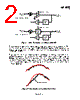
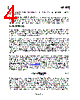
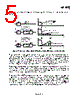
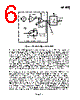
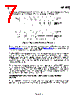
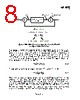
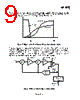


1. Introduction and Historical Context:
️· What are Sigma-Delta ADCs? They're a type of ADC known for high resolution and noise reduction, particularly useful when you need to convert analog signals to digital with high accuracy. They're a key technology in audio, instrumentation, and other applications.
️· History - A Long Development: The tutorial traces the evolution of Sigma-Delta ADCs, spanning from the 1940s to the 1970s. It highlights the contributions of multiple inventors and labs (including International Telephone and Telegraph Corporation, Bell Labs, and others). The development wasn't a single "eureka" moment but a series of incremental improvements.
️· Key Concepts Introduced Early On: The history highlights the evolution of concepts like:
- Delta Modulation: An early precursor that involves encoding the *difference* between successive samples.
- Noise Shaping: A crucial technique where quantization noise is pushed to higher frequencies, where it's easier to filter out.
- Oversampling: Taking samples at a rate significantly higher than the Nyquist rate (the minimum rate required for accurate conversion) to improve resolution.
- Digital Filtering and Decimation: These are essential post-processing steps to remove the high-frequency noise and reduce the data rate to a usable level.
2. Core Principles and Operation:
️· Oversampling and Noise Shaping: The tutorial emphasizes that oversampling allows for noise shaping – shifting the quantization noise to higher frequencies that can be filtered out in the digital stage.
️· First-Order vs. Higher-Order Modulators: The order of the modulator determines the rate at which noise is attenuated. Higher-order modulators provide better noise performance but can introduce stability challenges.
️· The Architecture: The core of a Sigma-Delta ADC consists of:
- Integrators: Accumulate the input signal.
- Comparator: Performs the crucial '1-bit' quantization (deciding if the integrated signal is above or below a threshold).
- Digital Filter & Decimation: Smooth the data and reduce the sampling rate.
3. Advanced Topics and Refinements:
️· Stability Challenges: Higher-order modulators can be susceptible to instability, which the tutorial mentions can be managed with DSP.
️· Multi-bit Sigma-Delta: Using multiple bits in the quantization stage can improve linearity and reduce noise.
️· MASH (Multi-bit Architecture with Single Loop): A specific architecture designed to improve performance.
️· Bandpass Sigma-Delta: Specialized for converting signals around a specific frequency.
4. Key Takeaways & Significance
️· Sigma-Delta ADCs are a Result of Collaborative Innovation: The development of this technology wasn't the work of a single inventor but the result of contributions from various individuals and labs over many years.
️· Noise Shaping and Oversampling are Essential: These techniques are what give Sigma-Delta ADCs their high resolution and noise performance.
️· Digital Signal Processing is Crucial: Digital filtering and decimation are indispensable for realizing the full benefits of the Sigma-Delta architecture.
️· Trade-offs Exist: Higher order, multi-bit architectures offer better performance but also present design and stability challenges.
5. References:
The extensive list of references provides a deep dive into the historical development of this technology.
1. Introduction and Historical Context:
️· What are Sigma-Delta ADCs? They're a type of ADC known for high resolution and noise reduction, particularly useful when you need to convert analog signals to digital with high accuracy. They're a key technology in audio, instrumentation, and other applications.
️· History - A Long Development: The tutorial traces the evolution of Sigma-Delta ADCs, spanning from the 1940s to the 1970s. It highlights the contributions of multiple inventors and labs (including International Telephone and Telegraph Corporation, Bell Labs, and others). The development wasn't a single "eureka" moment but a series of incremental improvements.
️· Key Concepts Introduced Early On: The history highlights the evolution of concepts like:
- Delta Modulation: An early precursor that involves encoding the *difference* between successive samples.
- Noise Shaping: A crucial technique where quantization noise is pushed to higher frequencies, where it's easier to filter out.
- Oversampling: Taking samples at a rate significantly higher than the Nyquist rate (the minimum rate required for accurate conversion) to improve resolution.
- Digital Filtering and Decimation: These are essential post-processing steps to remove the high-frequency noise and reduce the data rate to a usable level.
2. Core Principles and Operation:
️· Oversampling and Noise Shaping: The tutorial emphasizes that oversampling allows for noise shaping – shifting the quantization noise to higher frequencies that can be filtered out in the digital stage.
️· First-Order vs. Higher-Order Modulators: The order of the modulator determines the rate at which noise is attenuated. Higher-order modulators provide better noise performance but can introduce stability challenges.
️· The Architecture: The core of a Sigma-Delta ADC consists of:
- Integrators: Accumulate the input signal.
- Comparator: Performs the crucial '1-bit' quantization (deciding if the integrated signal is above or below a threshold).
- Digital Filter & Decimation: Smooth the data and reduce the sampling rate.
3. Advanced Topics and Refinements:
️· Stability Challenges: Higher-order modulators can be susceptible to instability, which the tutorial mentions can be managed with DSP.
️· Multi-bit Sigma-Delta: Using multiple bits in the quantization stage can improve linearity and reduce noise.
️· MASH (Multi-bit Architecture with Single Loop): A specific architecture designed to improve performance.
️· Bandpass Sigma-Delta: Specialized for converting signals around a specific frequency.
4. Key Takeaways & Significance
️· Sigma-Delta ADCs are a Result of Collaborative Innovation: The development of this technology wasn't the work of a single inventor but the result of contributions from various individuals and labs over many years.
️· Noise Shaping and Oversampling are Essential: These techniques are what give Sigma-Delta ADCs their high resolution and noise performance.
️· Digital Signal Processing is Crucial: Digital filtering and decimation are indispensable for realizing the full benefits of the Sigma-Delta architecture.
️· Trade-offs Exist: Higher order, multi-bit architectures offer better performance but also present design and stability challenges.
5. References:
The extensive list of references provides a deep dive into the historical development of this technology.
| Part No. | MT-022 |
| Manufacturer | AD |
| Size | 295 Kbytes |
| Pages | 12 pages |
| Description | ADC Architectures III: Sigma-Delta ADC Basics |
| ALLDATASHEET é útil para você? [ DONATE ] |
Sobre Alldatasheet | Publicidade | Contato conosco | Privacy Policy | Link para a ficha técnica | roca de Link | Lista de Fabricantes All Rights Reserved©Alldatasheet.com |
| Russian : Alldatasheetru.com | Korean : Alldatasheet.co.kr | Spanish : Alldatasheet.es | French : Alldatasheet.fr | Italian : Alldatasheetit.com Portuguese : Alldatasheetpt.com | Polish : Alldatasheet.pl | Vietnamese : Alldatasheet.vn Indian : Alldatasheet.in | Mexican : Alldatasheet.com.mx | British : Alldatasheet.co.uk | New Zealand : Alldatasheet.co.nz |
|
Family Site : ic2ic.com |
icmetro.com |
 Portuguese ▼
  English
 Chinese
 German
 Japanese
 Russian
 Korean
 Spanish
 French
 Italian
 Polish
 Vietnamese
 Indian
 Mexican
 British
 New Zealand